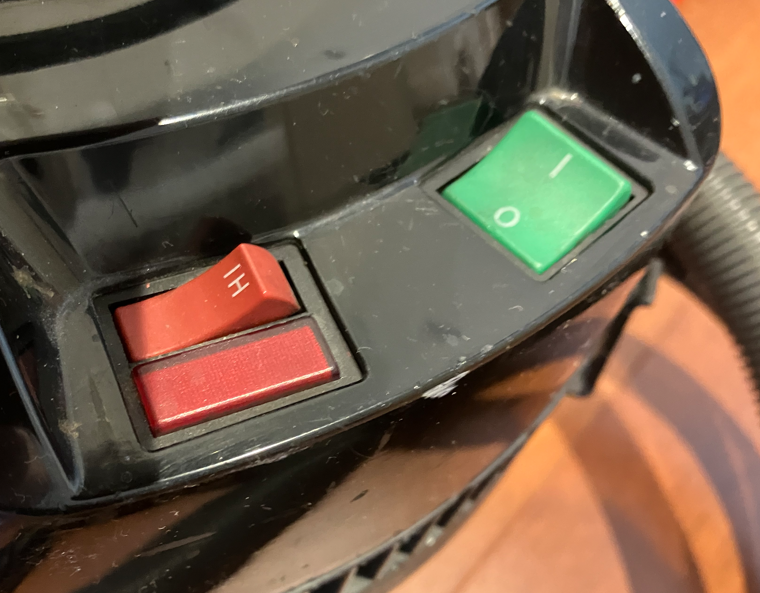
Blog 10th April 2026 – Henry Vacuum Cleaner (with Hi switch) won't fire up He Is Risen! Happy Easter! I vacuumed the house a week or so ago... top to bottom using our trusted Henry machine but when I plugged it in this afternoon... dead. I checked the mains socket and fuse in the plug... but both were ok. Our particular Henry is the model fitted with a "HI" switch - resulting from yet another piece of EU net zero overreach where any electrical device that worked reasonably well was forced by law to work less well in order to "Save the Environment". The solution conjured up by the manufacturer was to fit an extra momentary HI switch alongside the standard ON/OFF and to add a small control PCB internally to moderate the voltage fed to the motor. I haven't reverse engineered the board but suspect they used a thyristor to half the voltage when in the Lo (sic) speed mode. From switch on, the Henry always starts at half speed. In the first 2-3 seconds of running, the Hi switch is actually ignored, but if pressed and held for a second after that delay, the motor will up-tempo to full speed mode. I guess the law assumed that most folks would tend to leave Henry on the LO setting (regardless of the tempting switch marked Hi nearby?!?) - and they then used an extra 2-3 second delay to reinforce the selection. That said, in a past job I knew a group of very professional cleaners all of who rated Henry vacuums while loathing this specific feature and knowing precisely how to undo it. At the time we bought the machine, we didn't actually have any choice but whenever we used Henry, we switched it on... patiently waited a second or two and always flipped it to Hi speed. I never used it on Lo power because... (spoiler alert...) it couldn't vacuum worth a damn at that speed.
Henry Vacuum Front Panel Buttons
Anyway opening up the Henry is easy. Remove the head motor/switch assembly from the base and turn it upside down where you'll find 7 self tapping screws. Remove these and the two main parts of motor housing and cable control can be split. Cable control uses a pair of sprung contacts to make the electrical connections to slip rings on the head of the motor unit - and provide a natural place to check for mains continuity. Obviously those bare sprung contacts are live when the cable is plugged in, so do be cautious. There is also a small plastic cover in the front of the switches which can be levered away to expose the switch wiring. It uses a brush motor with two white wires as its feed. After checking mains all the way through the design, I strongly suspected the moderating HI/LO PCB was the problem... and so simply removed the two white wires of the motor, connecting them directly to the other side of the mains switch. At that point, once the mains switch was thrown Henry burst into life and at full speed. The Hi switch is now redundant but I could always fit a neon or LED indicator in its place if required.
Funny enough, this is one of those fairly rare repairs where the fix ends up making the device better than the original. Yay!! Comment | Back to Quick Links...